Author: Gordon Nunn

I play drumset and hand percussion with bands based in Pittsburgh and Cumberland, MD. Additionally, I accompany dance classes at Point Park University, Pittsburgh Ballet Theatre's outreach programs, and Carnegie Mellon University's Pre-College Drama programs. I teach lessons at my private studio at the Monroeville Music Lesson Center, Norwin High School and The Music Note in Ben Avon.

Wednesday Night West African Drumming Classes Resume This Wednesday

I will be teaching a West African drumming class at Brighton Music Center on three successive Wednesday nights beginning August 8 to August 22 from  6:30-8:00 p.m. The class will be for beginner to intermediate level drummers. I will bring along two or three loaner djembes; the dunduns will be provided.
 
Description
Over the course of three classes we’ll learn basics of hand drumming and play djembe drumming pieces from Mali and Guinea, West Africa. Participants will have the opportunity to learn the djembe and dundun rhythms associated with each piece. We’ll also learn songs that go with the drumming, as well as musical arrangements for the ensemble. There will also be an opportunity to learn drum solos that go with each piece.
 
Schedule
Classes will take place on August 8, 15, 22.
 
Cost
You can pay for the course in two ways: all three classes for $50, or If you’d prefer to drop for a single class the cost will be $20.
 
Location
Brighton Music Center is located at 2110 Babcock Blvd., Pittsburgh, PA 15209
Phone: 412.821.5908
 
Students Should Bring
Students can bring a small recording device and a pad and paper if they want to document the information provided in the class.


Summer West African Drumming Class

I will be teaching a West African drumming class at Brighton Music Center on Wednesday nights beginning July 11 to August 22 from 6:30-8:00 p.m. The class will be for beginner to intermediate level drummers.

Over the course of six classes we’ll learn the basics of hand drumming and play djembe drumming pieces from Mali and Guinea in West Africa. Participants will have the opportunity to learn the djembe and dun dun and rhythms associated with each piece. We’ll also learn songs that go with the drumming, as well as musical arrangements for the ensemble. There will also be an opportunity to learn drum solos that go with each piece.

Classes will take place in July 11, 18, 25 and August 8, 15, 22 – there’s no class on August 4.

You can pay for the course in two different packages: all six classes for $75 or three classes for $50. If you’d prefer to drop for a single class the cost will be $20.

Question: If I were to get a new drumset… should I got with Yamaha or Mapex? I like both of them a lot.

Answer: Most drum companies offer lines of drums sets that range in quality from an entry-level instrument to the custom quality drums that professionals use for touring and recording. And they also build drums that somewhere between the two extremes. Yamaha and Mapex both offer different 8 models of drums.

Do your research:
Know what the drum is made of. Most drum companies offer drum shells built from a variety of woods: maple, birch, oak, poplar and sometimes exotic woods and even blends of two or more layered in multiple-ply drums. Maple and birch shells as well those made from exotic woods are commonly used for the top of line drums, and each of these woods produce different sound qualities. The mid-level drums are made of oak, popular as well maple and birch. What separates the top tier drums from the middle level are the way the shell are constructed, the number of plies and even mounting system used to attach the tom toms to the bass drum. With lower-end drums the companies don’t usually mention the type of wood that used. I recommend that you go to a drum shop or a high-end music retailer like Guitar Center and listen to the different shell types for your self.

Size counts:
Companies offer drums in a variety of sizes from power with extra depth, the traditional and experimental sizes. Drummers choose sizes based on the type of music they are playing. Again, here’s where your research comes in. Who are your favorite drummers and what type music do they play. Find out the sizes that they use as a starting point. What type of music are you going to be playing. Generally, drummers playing rock or funk prefer 22” by 16” bass drums, while jazz drummers like 18” by 14 or 16” bass drums.

Hardware:
In the same way that companies offer different models drums, they make different styles of hardware from lightweight to heavy-duty. Think about how often your going to be hauling a case filled with lots of cymbal and snare drum stands, along with mounting system. It can get pretty heavy

Your budget:
In the end a lot will be determined by how much money you have to spend. However, with companies like Yamaha and Mapex your going to get good drums at every level.

Question: Do you make up the “breaks” that we play in our djembe drumming ensemble or are they taken from some where else?

My response:

I’ve composed a few djembe breaks and collaborated with other drummers to create them; however, most of the ones that I incorporate are ones that I’ve learned from my teachers.
They are traditional in the sense that they have been passed down by drummers that come from core djembe areas in Mali and Guinea in West Africa. Some of these breaks have become well known because they were created within the national folkloric ensembles such as Percussions de Guinee and Ballets Africaines and were widely disseminated via the recordings and videos of their performances.
Many working drummers in Mali and Guinea have their own groups. They often create their own short breaks that they use in the context of the ceremonies and festivals where they play.
All that said, in most of the drumming I’ve experienced at drumming activities in Guinea and Mali, these things aren’t played at all. Drummers are more involved with the success of ceremony and playing the rhythms to accompany the dancing and singing that’s taking place. Also, the drum ensemble may consist of various drummers that were “rounded up” for a particular and don’t usually play together, therefore they may not be familiar with each other’s “breaks.”
Drum enthusiasts call this style of playing: “traditional” drumming. And the type of drumming found in organized drum and dance ensembles where the emphasis is on creating an exciting performance is called “ballet style” drumming.
If anyone has any questions about drumming from any culture, I’d be glad to do my best to answer it, or point the way to more information on the subject.

Gordon Nunn

New Year’s Performance with Americas Latin Orchestra

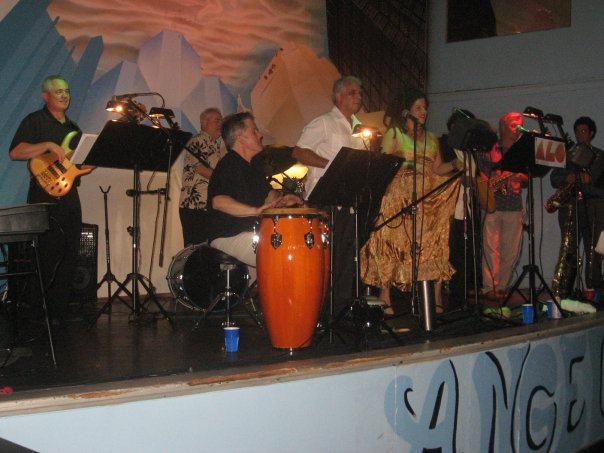
I’ll be performing with the Americas Latin Orchestra (ALO) at Pittsburgh CAPA Creative and Performing Arts High School, as part of the First Night Celebration. I’m the conguero with this Latin jazz big band, which performs the music in the style of Ray Barretto and Poncho Sanchez. The group will perform three 45 minute sets between 7 and 11 p.m.

Last year’s performances drew over a thousand people.